Mean BP Calculator
Free mean BP calculator. Enter your blood pressure to get your mean arterial pressure (MAP), pulse pressure and blood pressure category, or average a week of home readings in one place.
- Free
- No sign up
- Runs in your browser
Mean arterial pressure and average blood pressure
Type your blood pressure reading. MAP, pulse pressure and your blood pressure category update as you type.
Enter each reading on its own row, or paste them all at once (for example 128/84, 131/86, 125/80). Empty rows are skipped.
| # | Systolic | Diastolic | Pulse |
|---|
For information only, not a diagnosis. A reading higher than 180/120 with chest pain, shortness of breath, weakness, vision or speech problems needs emergency care: call 911.
Your recent calculations
Mean BP at a glance
What the mean BP calculator tells you, in four ideas
One blood pressure reading holds more information than the two numbers on the screen. These are the four ideas behind every result on this page.
The formula
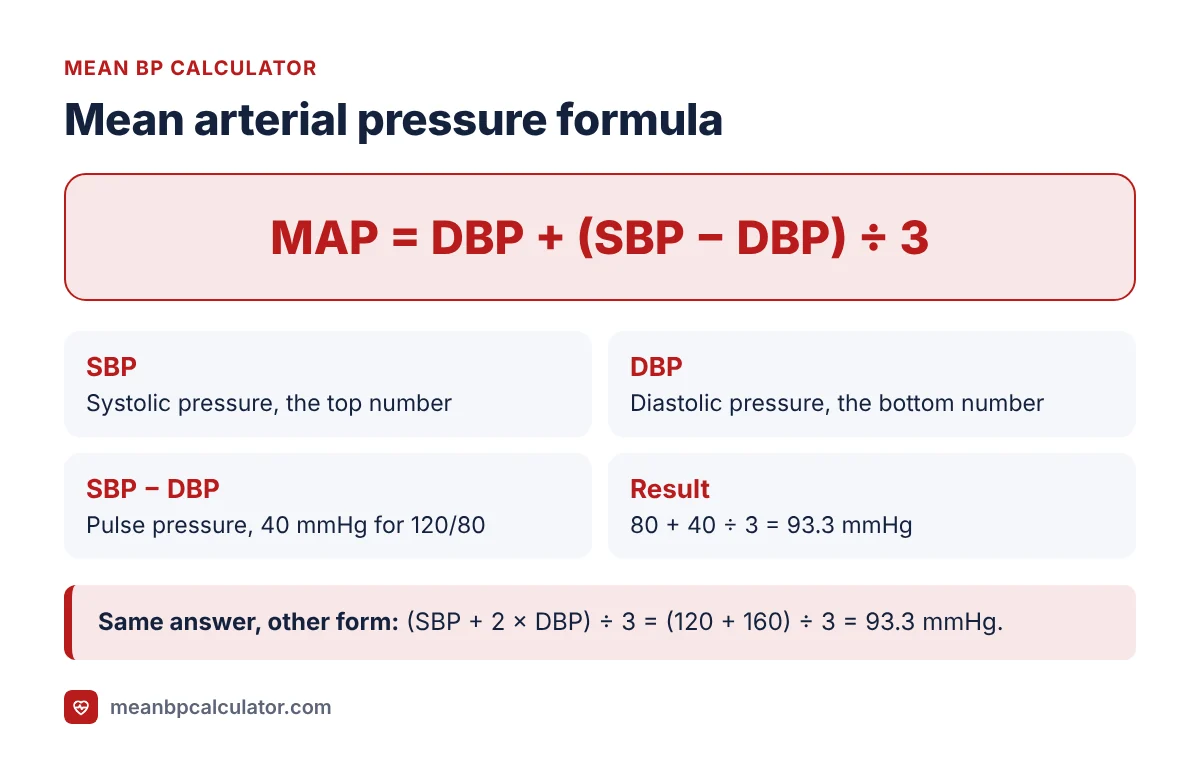
MAP = diastolic + one third of the pulse pressure. For 120/80 that is 93.3 mmHg.
The normal range
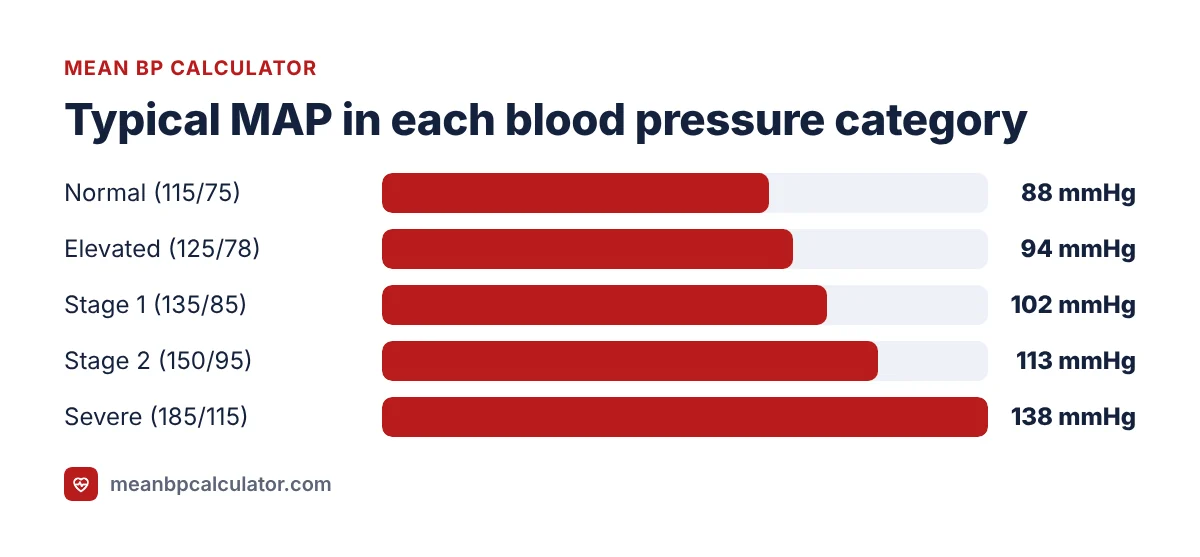
A healthy adult at rest usually has a MAP of 70 to 100 mmHg. Below 60 to 65 the organs may not get enough blood.
The pulse pressure
The gap between the two numbers, about 40 mmHg when things are typical. A wide gap often points to stiff arteries.
The average
One reading can mislead. The average of a week of home readings is what doctors use to judge your blood pressure.
The basics
What is mean BP?
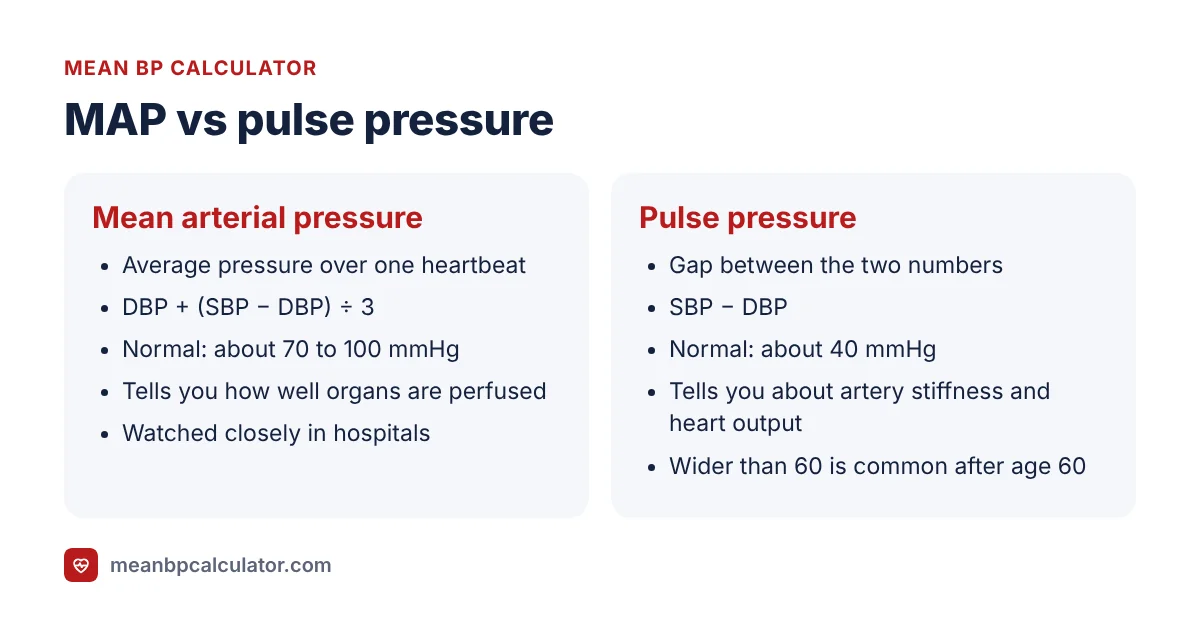
Mean BP, short for mean blood pressure, almost always means mean arterial pressure, or MAP. It is the average pressure in your arteries over one complete heartbeat, and it is the pressure that actually pushes blood into your brain, heart, kidneys and every other organ.
A blood pressure reading such as 120/80 gives you the highest pressure, when the heart contracts (systolic), and the lowest, when it relaxes and refills (diastolic). Your arteries spend every moment somewhere in between. MAP condenses that whole wave into one number, which is why nurses, paramedics and intensive care teams watch it so closely.
A mean BP calculator does the math for you. Type the two numbers from your monitor and you get the MAP, the pulse pressure and your blood pressure category, with every step of the calculation shown.
Why mean BP is not the simple average of the two numbers
Add 120 and 80, divide by two, and you get 100. The real mean arterial pressure for 120/80 is 93.3 mmHg. At a resting heart rate your heart spends roughly one third of each beat pumping and two thirds relaxing, so the pressure sits near the diastolic value for most of the time. That is why the formula counts the bottom number twice.
The math
Mean arterial pressure formula
The standard MAP formula needs only your systolic and diastolic pressure. It can be written two ways, and both give exactly the same answer.
120/80: 80 + 40 ÷ 3 = 93.3 mmHg
120/80 at 120 bpm: 99.0 mmHg
120/80: 80 + 0.412 × 40 = 96.5 mmHg
The one third rule assumes a resting heart rate of roughly 60 to 80 beats a minute. When the heart beats faster, the relaxed phase gets shorter, systole takes up a bigger share of each beat, and the true average pressure moves up. Razminia and colleagues tested this against pressures measured inside the aorta and published a correction that adds 0.0012 for every beat per minute (Catheterization and Cardiovascular Interventions, 2004). The calculator shows this heart rate adjusted MAP as soon as you enter your pulse.
A second variation, DBP plus 0.412 of the pulse pressure, came out of work by Meaney and colleagues comparing cuff readings with directly measured pressure (Heart, 2000). It explains why the MAP printed by some automatic monitors is a few points higher than the one you work out by hand. Neither variation is wrong: they are different estimates of the same thing, and the standard formula remains the one taught in nursing and medical school.
You can also run the formula backwards. If you know the MAP and one of the two pressures, the other is SBP = 3 × MAP − 2 × DBP, or DBP = (3 × MAP − SBP) ÷ 2. The third tab of the calculator does this for you, which is handy for exam questions.
Step by step
How to use the mean BP calculator
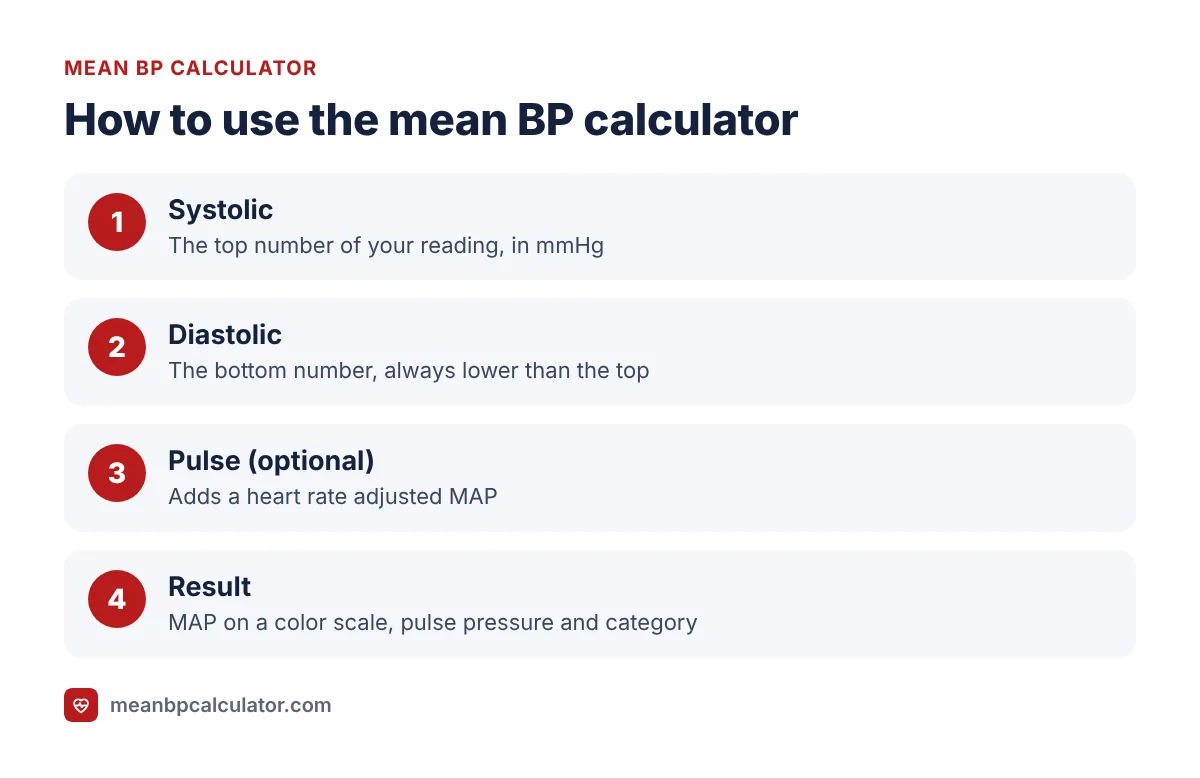
The calculator opens with a sample reading so you can see how it works. Replace the numbers with your own and every result updates as you type.
Enter the systolic pressure
This is the top, larger number on your monitor or in your notes. Blood pressure is measured in millimeters of mercury, written mmHg.
Enter the diastolic pressure
The bottom, smaller number. If you swap them by mistake, the calculator tells you, because the diastolic is always lower.
Add your pulse if you have it
Most home monitors also show your heart rate. It is optional, but with it you also get the heart rate adjusted MAP.
Read your results
You see the MAP with a pointer on a color scale, a plain English note on what it means, your pulse pressure, your blood pressure category under the 2025 ACC/AHA guideline and the MAP in kPa, plus the full calculation.
Average several readings
On the Average of readings tab, type each reading on its own row or paste a list such as 128/84, 131/86. You get the average blood pressure, its MAP and category, your average pulse and the spread of your readings.
Work backwards when you need to
The Find SBP or DBP tab solves for the missing pressure when you know the MAP and one of the two numbers.
Tip: “Share link” copies a link with your numbers in it, so you can send a reading or a week of readings to a family member or your care team. Recent calculations stay on your own device only.
Worked example
How to calculate mean arterial pressure by hand
Say your monitor shows 135/85 with a pulse of 72. Walking through it once shows exactly what the calculator does.
First find the pulse pressure: 135 − 85 = 50 mmHg. Take one third of it: 50 ÷ 3 = 16.7. Add that to the diastolic pressure: 85 + 16.7 = 101.7 mmHg. That is your mean arterial pressure.
A MAP of 101.7 sits just above the usual 70 to 100 range. The reading itself, 135/85, is stage 1 high blood pressure under the 2025 ACC/AHA guideline, and the MAP tells the same story in a single number. With the pulse of 72, the heart rate adjusted MAP comes out a little higher, at 105.8 mmHg, because that formula gives the systolic pressure slightly more weight even at a normal resting rate.
Change one number and watch the MAP move
The diastolic pressure moves the MAP twice as much as the systolic. These four changes to the 135/85 example show it.
Know your mean arterial pressure in seconds
Type the two numbers from your blood pressure monitor. The calculator does the rest.
Calculate my MAP Free, no sign up, runs in your browserQuick reference
MAP chart: mean arterial pressure for common readings
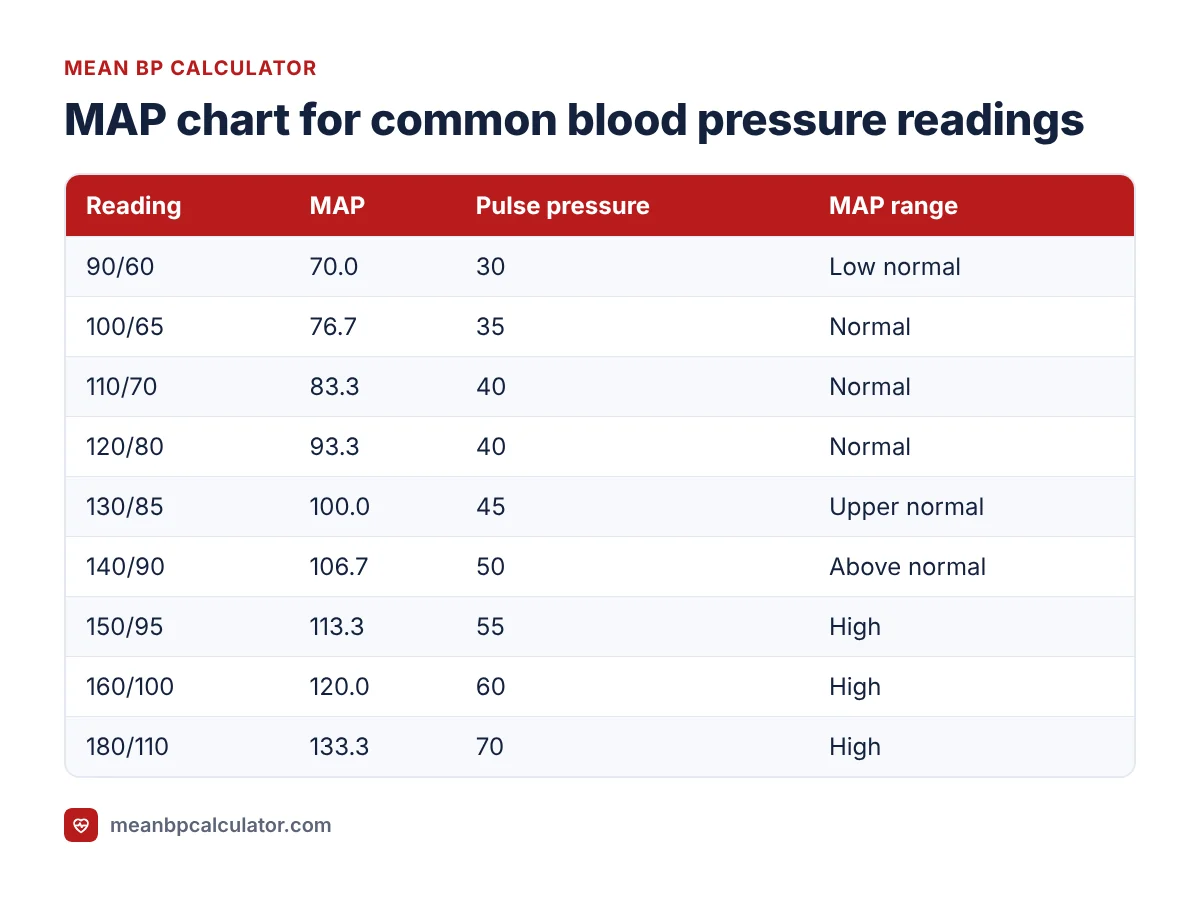
If you just want to look up a reading, this MAP chart lists the mean arterial pressure and pulse pressure for the readings people check most often. For anything in between, the calculator gives you the exact value.
Notice how the MAP climbs about 6 to 7 mmHg for every step of 10 on top and 5 on the bottom. A reading of 140/90, the line where stage 2 high blood pressure starts, already has a MAP of 106.7, above the normal range.
Nurses sometimes keep a chart like this on a pocket card, but the formula is simple enough to do in your head once you know the trick: find the gap, divide it by three, and add it to the bottom number.
Reading the result
What is a normal mean arterial pressure?
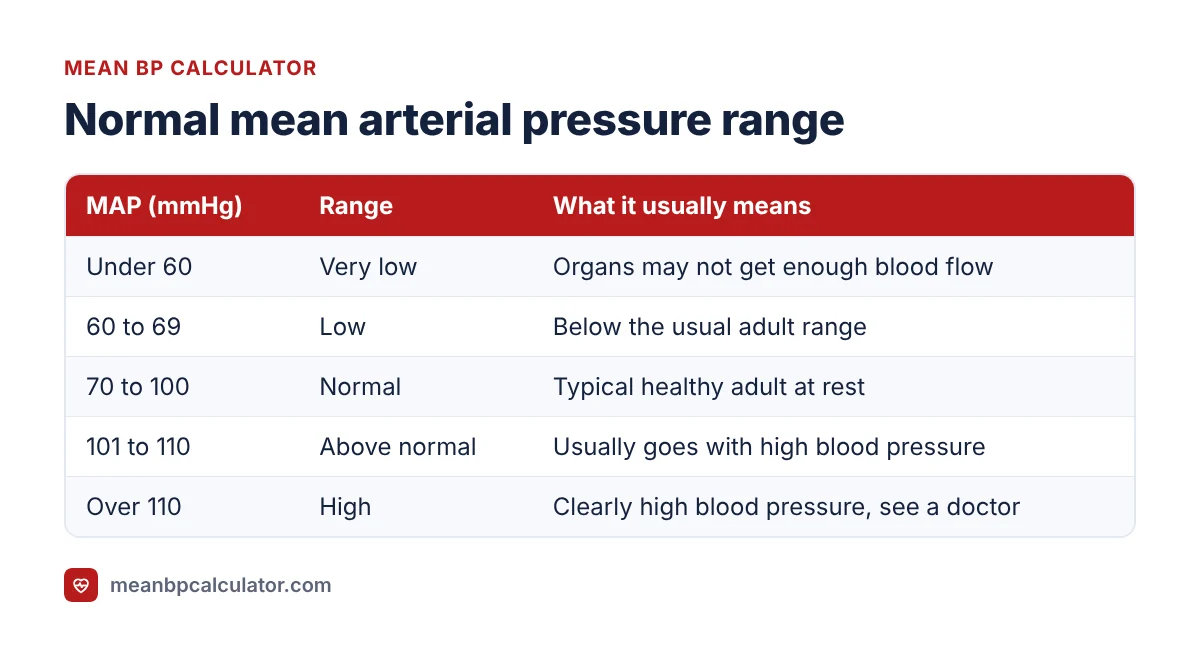
For a healthy adult at rest, a normal MAP is about 70 to 100 mmHg. The color scale in the calculator uses the five ranges below.
The lower limit matters most in hospitals. A MAP of at least 60 mmHg is generally needed to keep blood flowing through the coronary arteries, the brain and the kidneys, according to the StatPearls review of MAP physiology (DeMers and Wachs, NCBI Bookshelf). Below that, organs start to run short of oxygen.
The upper end is about the long run. A MAP that stays above 100 means your arteries carry more pressure than they should, beat after beat, which over years strains the heart, the kidneys and the small vessels in the brain and eyes.
Your MAP also changes through the day. It dips during sleep, rises when you wake up, and jumps with stress, pain, caffeine and exercise. That is why a single number is never the whole picture.
| Result | What it is | How to read it |
|---|---|---|
| Mean arterial pressure | Average pressure over one heartbeat | 70 to 100 mmHg is normal at rest; under 60 is too low for good perfusion |
| Pulse pressure | Systolic minus diastolic | About 40 is typical; over 60 often means stiffer arteries |
| Blood pressure category | Your reading against the 2025 ACC/AHA thresholds | Normal, elevated, stage 1, stage 2 or severe; the higher number decides |
| MAP adjusted for heart rate | Razminia formula using your pulse | Close to the standard MAP at rest; higher when the pulse is fast |
| MAP in kPa | MAP × 0.1333 | The unit used in some countries and in physiology textbooks |
When MAP is low
Low mean arterial pressure: what it means
A low MAP means the pressure driving blood into your organs has dropped. Whether that matters depends on how low it is and how you feel.
Common, harmless causes
Some fit, young people and many people of small build simply run low, with readings around 95/60 and a MAP near 72, and feel fine. Standing up quickly, dehydration on a hot day or a big meal can all lower it for a short while.
Causes that need attention
Blood or fluid loss, severe infection (sepsis), heart problems, serious allergic reactions and some blood pressure and heart medicines can push MAP down. Here a low number is a warning sign, not a lucky one.
Symptoms to watch for
Dizziness or fainting, blurred vision, confusion, cold and clammy skin, fast shallow breathing and passing little urine. Low numbers with these symptoms need a doctor, and fainting or confusion need urgent care.
The 65 mmHg target in hospital
For adults with septic shock, the Surviving Sepsis Campaign guidelines recommend an initial MAP target of 65 mmHg when vasopressor medicines are used (SCCM, 2021).
MAP also appears in brain injury care. Cerebral perfusion pressure, the pressure that pushes blood into the brain, is MAP minus the pressure inside the skull: CPP = MAP − ICP. Guidelines from the Brain Trauma Foundation aim for a CPP of roughly 60 to 70 mmHg after a severe head injury, so the care team keeps MAP high enough to reach it.
When MAP is high
High mean arterial pressure: what it means
A MAP over 100 mmHg almost always goes with high blood pressure, because the MAP is built from your two numbers. A MAP of 107 matches a reading of 140/90, and 120 matches 160/100.
High blood pressure rarely causes symptoms, which is why it is called the silent killer. Year after year the extra pressure stiffens and damages the arteries, makes the heart work harder and raises the risk of heart attack, stroke, heart failure, kidney disease and vision loss.
The good news is that it responds to treatment. Less salt, more potassium rich foods, regular activity, a healthy weight, less alcohol and not smoking all bring blood pressure down, and when they are not enough, medicines work well. Lowering your average reading lowers your MAP with it.
When to get help now: a reading higher than 180/120 is severe. Wait a few minutes and measure again. If it stays that high, call your doctor. If you also have chest pain, shortness of breath, back pain, numbness or weakness, a change in vision or trouble speaking, call 911.
Guidelines
Blood pressure categories under the 2025 ACC/AHA guideline
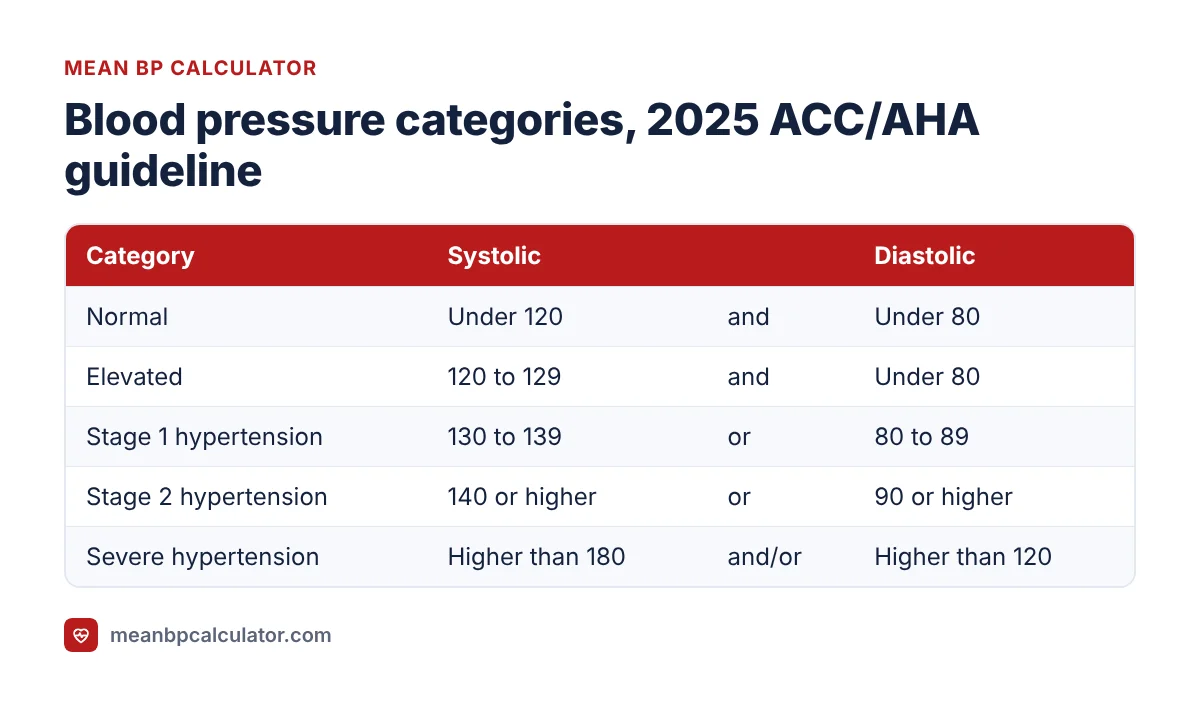
Next to your MAP, the calculator places your reading in one of the adult categories from the 2025 high blood pressure guideline of the American College of Cardiology and the American Heart Association. The thresholds are the same as in the 2017 guideline.
The rule that surprises most people: when your two numbers fall in different categories, the higher one counts. A reading of 118/84 is stage 1, because the diastolic is in the 80 to 89 range, even though the top number is normal. It also means a reading of exactly 120/80 is not “normal” under this guideline.
The calculator also flags readings below 90/60 as low. That is not a guideline category, but it is the cut off most doctors use for low blood pressure.
The other number
Pulse pressure: the gap between your two numbers
Pulse pressure is the systolic minus the diastolic pressure. It comes free with every MAP calculation, and it tells you something MAP cannot.
Wide pulse pressure (over 60)
- Common after age 60 as the large arteries stiffen
- Can come with a leaky aortic valve, an overactive thyroid, anemia or fever
- Linked with a higher risk of heart disease in older adults
Narrow pulse pressure (under 25)
- Can mean the heart is pumping less blood with each beat
- Seen with heart failure, blood loss and a narrowed aortic valve
- Worth mentioning to a doctor, especially with symptoms
Two readings can share a MAP and still mean different things. 140/70 and 112/84 both have a MAP of about 93, but the first has a pulse pressure of 70, typical of stiff arteries, and the second only 28. That is why the calculator shows both numbers side by side.
Mean BP over days
How to calculate your average blood pressure
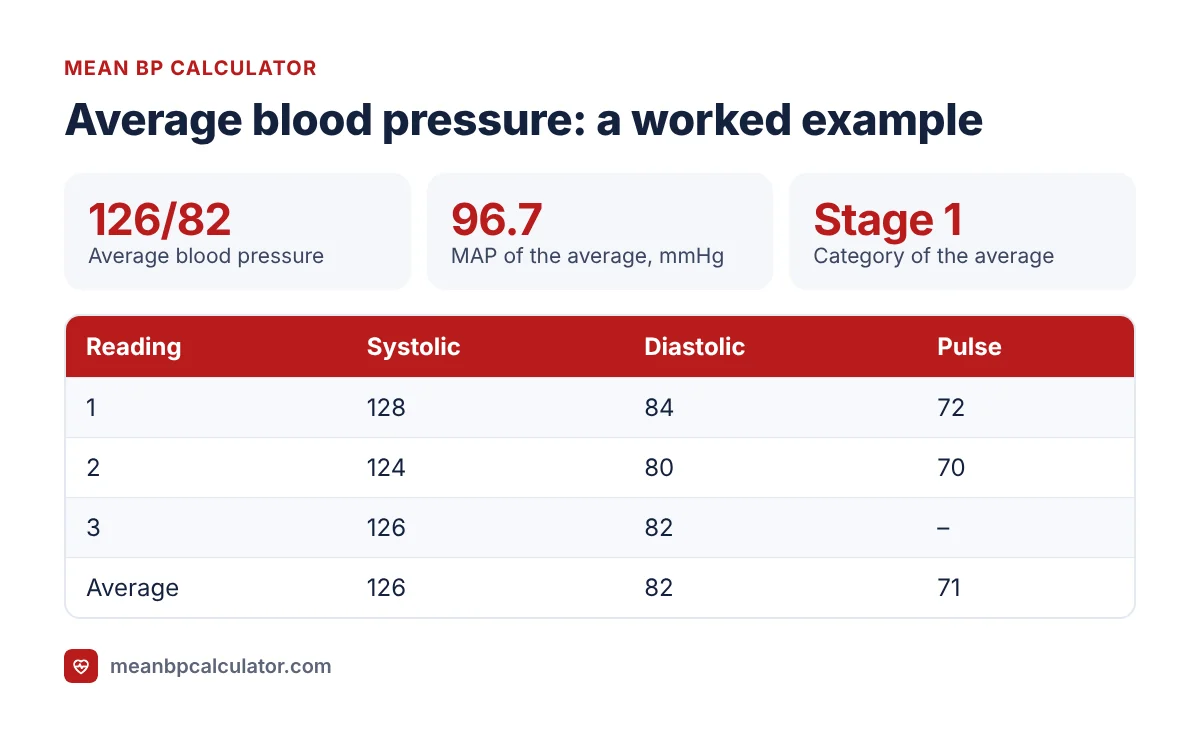
Some people searching for mean BP want something different: the average of several readings. Blood pressure changes from minute to minute, so one reading at the pharmacy or the doctor’s office can be off by 10 points or more in either direction. White coat hypertension, where readings are high only at the clinic, and masked hypertension, where they are high only at home, are both common.
That is why the 2025 ACC/AHA guideline recommends confirming high blood pressure with readings taken outside the office. The average of those home readings is the number your doctor will look at.
To work it out, add the systolic numbers and divide by how many readings you have, then do the same for the diastolic numbers. The Average of readings tab does it for you, shows the MAP and category of the average, and lets you leave out the first reading of the set.
A simple home monitoring routine
Measure twice a day
Once in the morning before medicines, food and coffee, and once in the evening.
Take two readings each time
One minute apart. Write down both, or let your monitor save them.
Keep it up for a week
Seven days gives you more than the 12 readings that make an average reliable.
Average and share
Paste the readings into the calculator and share the link or the result with your doctor.
Accurate readings
How to measure blood pressure at home
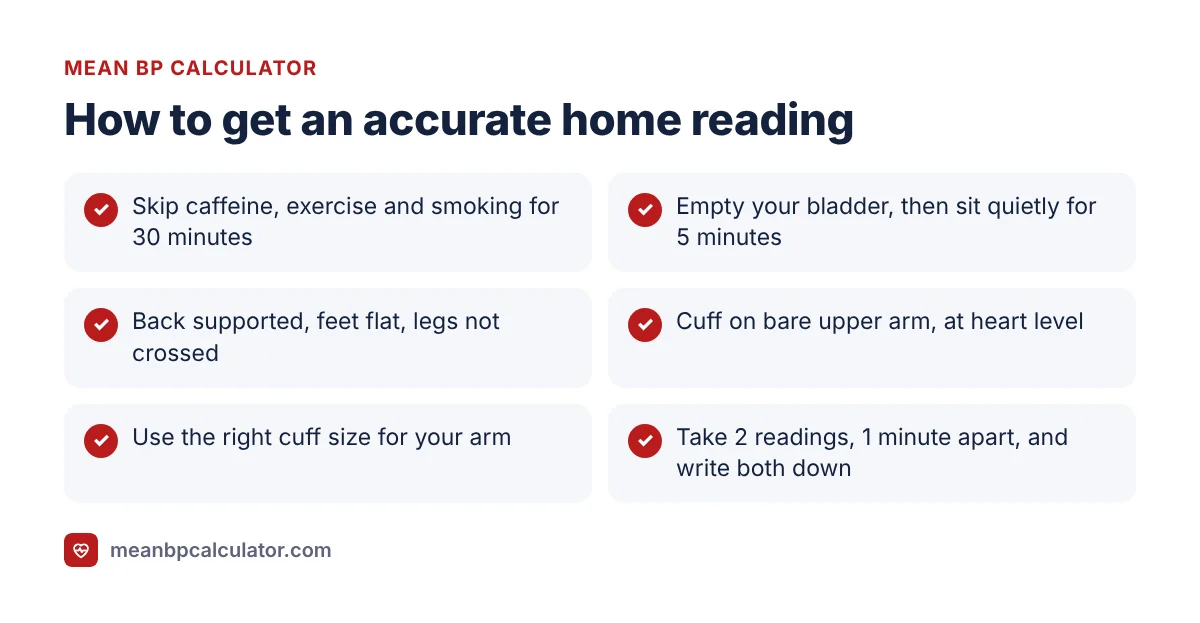
A calculator can only be as good as the reading you feed it. A full bladder, a cuff that is too small or talking during the reading can each add several points, and together they can turn a normal reading into a high one.
Use a validated automatic upper arm monitor; wrist and finger devices are less reliable. Measure on the same arm each time, and if one arm reads clearly higher, use that one. Bring your monitor to your next appointment once, so your doctor can check it against theirs.
The American Heart Association has a full checklist on monitoring your blood pressure at home, and the checklist here covers the steps that make the biggest difference.
In practice
Who uses a mean BP calculator
The formula is the same for everyone. What people need from it differs.
- At home
People checking their own readings
See what a reading means in plain English, track whether your average is falling, and send a clean summary to your doctor.
- Nursing
Nurses and nursing students
Check a MAP at the bedside, confirm a monitor value or practice for exams with the reverse tab and the written out steps.
- Emergency
Paramedics and EMTs
MAP helps judge perfusion in trauma, sepsis and shock, where a normal looking systolic can hide a falling diastolic.
- Critical care
ICU and anesthesia teams
MAP targets of 65 mmHg or more guide vasopressor doses, and many anesthetists keep MAP within about 20% of the patient’s baseline.
- Study
Medical and physiology students
Learn why diastole counts twice, how heart rate changes the estimate and how MAP links to cardiac output and resistance.
- Pregnancy
Expecting parents
MAP is one of the measures used in early pregnancy screening for preeclampsia. Your midwife or obstetrician interprets it with other tests.
Good to know
What a MAP calculator cannot tell you
The formula is an estimate. These are the situations where it is less accurate, or where the number needs a professional to interpret it.
Very fast or very slow heart rates
The one third rule assumes a normal resting pulse. Enter your heart rate to see the adjusted estimate, and expect the gap to grow above about 100 beats a minute.
Critically ill patients
In intensive care, an arterial line measures the pressure inside the artery beat by beat and calculates the true MAP. The formula is the bedside backup, not the reference.
Children
Normal blood pressure in children depends on age, sex and height percentiles. Adult ranges and categories do not apply.
A diagnosis
Only a health professional can diagnose high or low blood pressure, usually from repeated readings plus your history and other tests.
Questions
Mean BP calculator FAQ
Quick answers to the questions people ask most often about mean arterial pressure and this calculator.
How do you calculate mean BP?
Mean blood pressure, also called mean arterial pressure (MAP), is the diastolic pressure plus one third of the pulse pressure: MAP = DBP + (SBP − DBP) ÷ 3. For 120/80 that is 80 + 40 ÷ 3 = 93.3 mmHg. You can also write it as (SBP + 2 × DBP) ÷ 3, which gives the same answer.
What is a normal mean arterial pressure?
For a healthy adult at rest, MAP is usually between 70 and 100 mmHg. A MAP of at least 60 to 65 mmHg is generally needed to keep enough blood flowing to the brain, heart and kidneys.
Is mean BP the same as the average of the two numbers?
No. A simple average of 120 and 80 is 100, but the mean arterial pressure is 93.3. At rest your heart spends about two thirds of each beat relaxing and filling (diastole), so the diastolic pressure counts twice as much as the systolic.
What MAP is too low?
A MAP under 60 mmHg may not supply the brain, heart and kidneys with enough blood. In hospital care, teams often aim to keep MAP at 65 mmHg or higher in very ill patients, such as people with septic shock.
Is a MAP of 110 too high?
A MAP of 110 mmHg is above the normal range and usually goes with stage 2 high blood pressure, for example a reading of 145/92. One high reading is not a diagnosis, so measure again after resting and talk to your doctor if your average stays this high.
Should MAP be 60 or 65?
Both numbers are used. 60 mmHg is often quoted as the minimum for organ perfusion, while 65 mmHg is the usual starting target in intensive care for septic shock, as recommended by the Surviving Sepsis Campaign. Your care team sets the target for each patient.
What is the mean arterial pressure for 120/80?
The MAP for 120/80 is 93.3 mmHg: 80 + (120 − 80) ÷ 3 = 93.3. The pulse pressure is 40 mmHg.
What is pulse pressure and what is normal?
Pulse pressure is the difference between the top and bottom numbers. For 120/80 it is 40 mmHg, which is typical. A pulse pressure over 60 is common in older adults with stiffer arteries, and a very narrow one, under about 25, can be a sign that the heart is pumping less blood.
How do I average my blood pressure readings?
Add all the systolic numbers and divide by the number of readings, then do the same for the diastolic numbers. The Average of readings tab does this for you, also shows the MAP of the average and lets you leave out the first reading. Doctors trust an average of at least 12 home readings more than a single reading.
Why should I leave out the first reading?
The first reading of a session often runs higher because you have just sat down or feel tense. Many home monitoring protocols ask for two readings a minute apart and use the later ones. The calculator has a checkbox to leave out the first reading.
Does heart rate change the MAP?
Yes. The standard formula assumes a normal resting heart rate. When the heart beats faster, systole takes up a bigger share of each beat and the true MAP moves up. The calculator shows a heart rate adjusted MAP using the Razminia formula when you enter your pulse.
Is 120/80 normal or stage 1?
Under the ACC/AHA guideline, normal is below 120 and below 80. A reading of exactly 120/80 has a diastolic of 80, which falls in the stage 1 range of 80 to 89, while the systolic of 120 is elevated. In practice doctors look at your average over several days, not one reading.
Can I use this calculator for children or during pregnancy?
The MAP formula works for anyone, but what counts as normal is different. Children are judged against percentile charts for age, sex and height, and pregnancy has its own blood pressure thresholds. Use the numbers to talk with your pediatrician or midwife, not to judge them yourself.
Is this mean BP calculator free and private?
Yes. It is free with no sign up. All calculations run in your browser, and the numbers you type are not sent to or stored on our servers. Recent calculations are saved only on your own device.
Keep learning
Blood pressure guides
Each topic on this page has its own guide with more examples and charts.
- What is mean arterial pressure?MAP explained in plain English
- How to calculate MAPStep by step with examples
- Normal MAP by ageRanges for adults and older adults
- High MAPWhat it means and how to lower it
- Pulse pressure explainedWide, narrow and normal
- Blood pressure categoriesThe 2025 ACC/AHA thresholds
- Measuring BP at homeGet an accurate reading
- All blood pressure guidesBrowse the full library
Check your mean arterial pressure now
Enter one reading for your MAP, pulse pressure and category, or paste a week of readings to get your true average.
Open the mean BP calculator Free, no sign up, nothing stored on our serversHow this calculator works
The calculator uses the standard formula MAP = DBP + (SBP − DBP) ÷ 3. When you enter a heart rate between 30 and 220, it also shows the heart rate adjusted estimate DBP + (0.33 + HR × 0.0012) × (SBP − DBP) from Razminia and colleagues. Pulse pressure is SBP − DBP, and kPa values use 1 mmHg = 0.1333 kPa. Blood pressure categories follow the 2025 ACC/AHA guideline for adults, with readings under 90/60 marked as low. Averages are the arithmetic mean of the systolic and diastolic values you enter, and the category of the average uses the rounded averages.
Sources: DeMers D, Wachs D. Physiology, Mean Arterial Pressure. StatPearls, Razminia M et al. Validation of a new formula for mean arterial pressure calculation, 2004, Meaney E et al. Formula and nomogram for the sphygmomanometric calculation of the mean arterial pressure, Heart 2000, 2025 AHA/ACC High Blood Pressure Guideline, Surviving Sepsis Campaign 2021, American Heart Association: monitoring your blood pressure at home.
This calculator and page are for information and education. They are not medical advice and do not replace a diagnosis or treatment from a qualified health professional.
Last updated: November 2026